Most people chase complex routines, endless gym equipment, and expensive programs only to plateau. What if one exercise could outperform them all?

The truth is, simplicity wins. There’s one movement that builds raw strength, improves mental resilience, enhances posture, and transforms your body from the inside out. Let’s break it down.
What Makes the Pull-Up the Ultimate Full-Body Exercise?
The pull-up isn’t just an upper-body move it’s a full-system challenge that tests strength, coordination, and willpower simultaneously.
The pull-up is a compound, bodyweight exercise where you hang from a bar and pull your body upward until your chin clears the bar. It sounds simple. The results are anything but.
Here’s why it stands above the rest:
- Engages 15+ muscle groups in one movement
- Requires zero equipment beyond a bar
- Builds functional strength applicable to real life
- Improves grip strength, linked to longevity and overall health
- Scales with your fitness level from beginner to elite athlete
Unlike isolation exercises, the pull-up demands that your entire body work as a unit. That coordination is what makes it irreplaceable.
How Pull-Ups Build Muscle Far Beyond Your Back
Most people think pull-ups are a “back exercise.” That’s only part of the story.
When you perform a proper pull-up, here’s every major muscle group being activated:
| Muscle Group | Role in the Pull-Up |
|---|---|
| Latissimus Dorsi | Primary mover — creates the V-taper |
| Biceps Brachii | Assists in elbow flexion |
| Trapezius | Stabilizes the shoulder blades |
| Rhomboids | Retracts the scapula during the pull |
| Core (Abs & Obliques) | Prevents swinging; stabilizes the spine |
| Forearms & Grip | Maintains the bar hold throughout the rep |
| Rear Deltoids | Assists in shoulder extension |
This is why athletes across every sport from gymnastics to MMA rely on pull-ups as a staple. You can’t fake a pull-up. You either have the strength or you don’t.
Why Pull-Ups Are More Powerful Than Weightlifting Machines
Machines isolate. Pull-ups integrate. That difference defines everything.
Weight machines guide your movement through a fixed path. This protects beginners but limits neurological development. Pull-ups, by contrast, force your stabilizer muscles to engage constantly.
Here’s how they compare:
- Lat Pulldown Machine: Mimics the pull-up motion but removes bodyweight instability reducing core and stabilizer activation by up to 40%
- Cable Rows: Great for back thickness, but doesn’t challenge grip or shoulder stability the same way
- Pull-Ups: Full-chain activation, grip training, core stability, scapular control all in one rep
The result? Pull-up strength transfers to real-world movement in a way that machine training rarely does.
The Mental Strength Pull-Ups Build That No One Talks About
This is where most fitness articles stop. This one won’t.
Pull-ups are brutally honest. You cannot add less weight to make it easier (without assistance). Every rep is a negotiation between your body and gravity and your mind is the deciding factor.
How Pull-Ups Forge Mental Resilience
- Delayed gratification: Progress is slow and measurable. Each additional rep is a milestone.
- Failure tolerance: You will fail mid-rep. Learning to push through that moment builds psychological grit.
- Discipline over motivation: You won’t always “feel like” doing them. Doing them anyway builds identity-level discipline.
The Neurological Effect
- Compound movements like pull-ups increase brain-derived neurotrophic factor (BDNF) — the protein responsible for memory, focus, and mood regulation.
- Regular pull-up training has been linked to reduced cortisol levels, meaning lower chronic stress.
- The sense of accomplishment from hitting a new pull-up PR triggers dopamine release, reinforcing positive habits.
You’re not just building a stronger back. You’re building a stronger mind.
How to Start Pull-Ups at Any Fitness Level
You don’t need to be strong to start. You need to start to become strong.
Here’s a structured progression for every level:
Beginner: Zero Pull-Ups
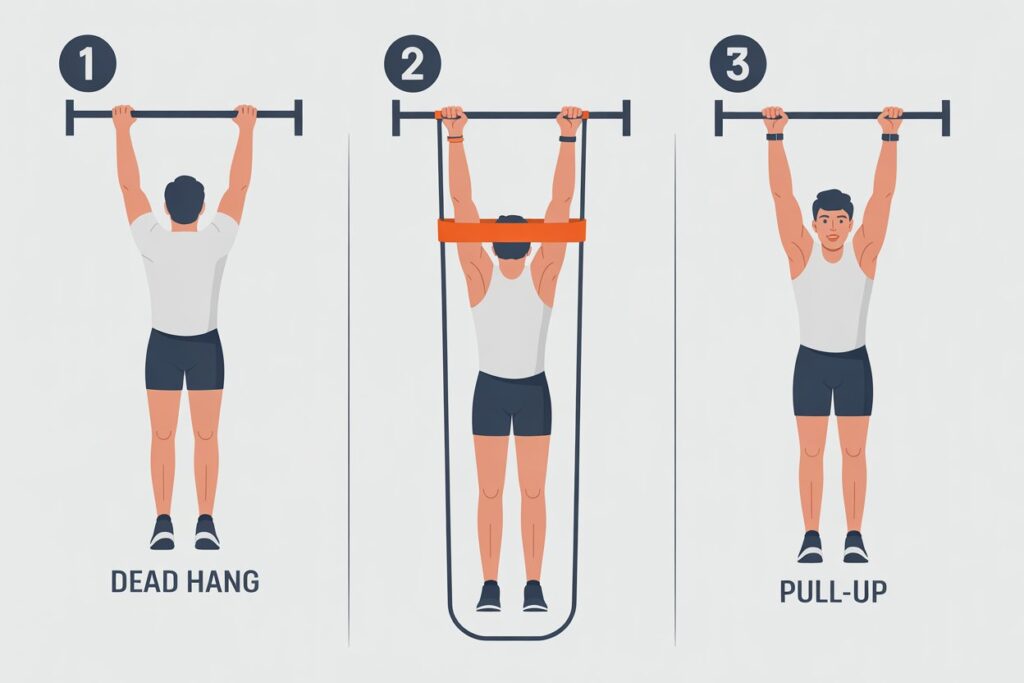
- Dead hangs> Hang from the bar for 20–30 seconds to build grip and shoulder stability
- Scapular pull-ups> Depress your shoulder blades without bending elbows; 3 sets of 8
- Resistance band-assisted pull-ups> Loop a band on the bar, step in, and perform full reps
Intermediate: 1–5 Pull-Ups
- Negative pull-ups> Jump to the top position, lower yourself slowly for 5–8 seconds
- Grease the Groove method> Do 2–3 pull-ups every hour throughout the day without failure
- Tempo training> 2 seconds up, 1 second hold, 3 seconds down
Advanced: 10+ Pull-Ups
- Weighted pull-ups> Use a dip belt or backpack with added weight
- Archer pull-ups> Shift weight to one arm for unilateral strength
- L-sit pull-ups> Extend legs parallel to the floor while pulling; extreme core demand
The Posture and Long-Term Health Benefits of Pull-Ups
Pull-ups don’t just sculpt your physique they correct the damage modern life does to your body.
Sitting at a desk for hours shortens your chest muscles and weakens your back. This creates the classic forward-hunched posture that plagues millions. Pull-ups directly counteract this pattern.
Postural Benefits
- Strengthens scapular retractors> Pulls shoulders back into alignment
- Lengthens the anterior chain> Stretches the chest and front shoulder during the hang phase
- Decompresses the spine> Hanging from a bar relieves lumbar pressure
Long-Term Health Outcomes
- Grip strength (a pull-up byproduct) is one of the strongest predictors of cardiovascular health and all-cause mortality, according to research published in The Lancet
- Bone density improvements from consistent bodyweight loading reduce osteoporosis risk
- Shoulder joint health improves when scapular muscles are properly developed
This is an exercise that pays dividends for decades not just for beach season.

How to Program Pull-Ups for Maximum Results
Consistency and smart programming are what separate average results from exceptional ones.
Here’s a simple, proven weekly structure:
| Day | Pull-Up Focus | Volume |
|---|---|---|
| Monday | Max effort sets | 4 × max reps |
| Wednesday | Tempo/controlled reps | 5 × 5 with 4-second negatives |
| Friday | Volume day | 8–10 sets of 3–5 reps |
| Saturday | Active recovery | Dead hangs + scapular work |
Key programming rules:
- Never train to failure every session> reserve max effort for once per week
- Rest 2–3 minutes> between working sets for full nervous system recovery
- Track your reps> progress in pull-ups is linear and measurable, use that to your advantage
- Add one rep or one set per week> micro-progressions compound rapidly over months
Pair pull-ups with push-up variations and core work for a complete upper-body routine that requires zero gym membership.

Asad Ullah is the founder and lead researcher at CombatFitnessScore.com, a resource dedicated to helping U.S. Army soldiers, ROTC cadets, and fitness enthusiasts understand and prepare for the Army Fitness Test (AFT).
With a deep interest in military fitness and physical readiness, [Author Name] has spent considerable time studying official U.S. Army regulations, FM 7-22 (Army Physical Readiness Training), and the latest AFT scoring standards published by the Department of the Army.
Every article and calculator on this site is built on official Army data — not guesswork. [Author Name] regularly updates content to reflect the latest policy changes, including the 2025 transition from the ACFT to the AFT.
What this site covers:
AFT & ACFT scoring standards by age, gender, and MOS
Training tips based on Army-approved methods
Score calculators updated with the latest 2026 data
Have a question or found an error? Reach out at [email] — accuracy is our top priority.